
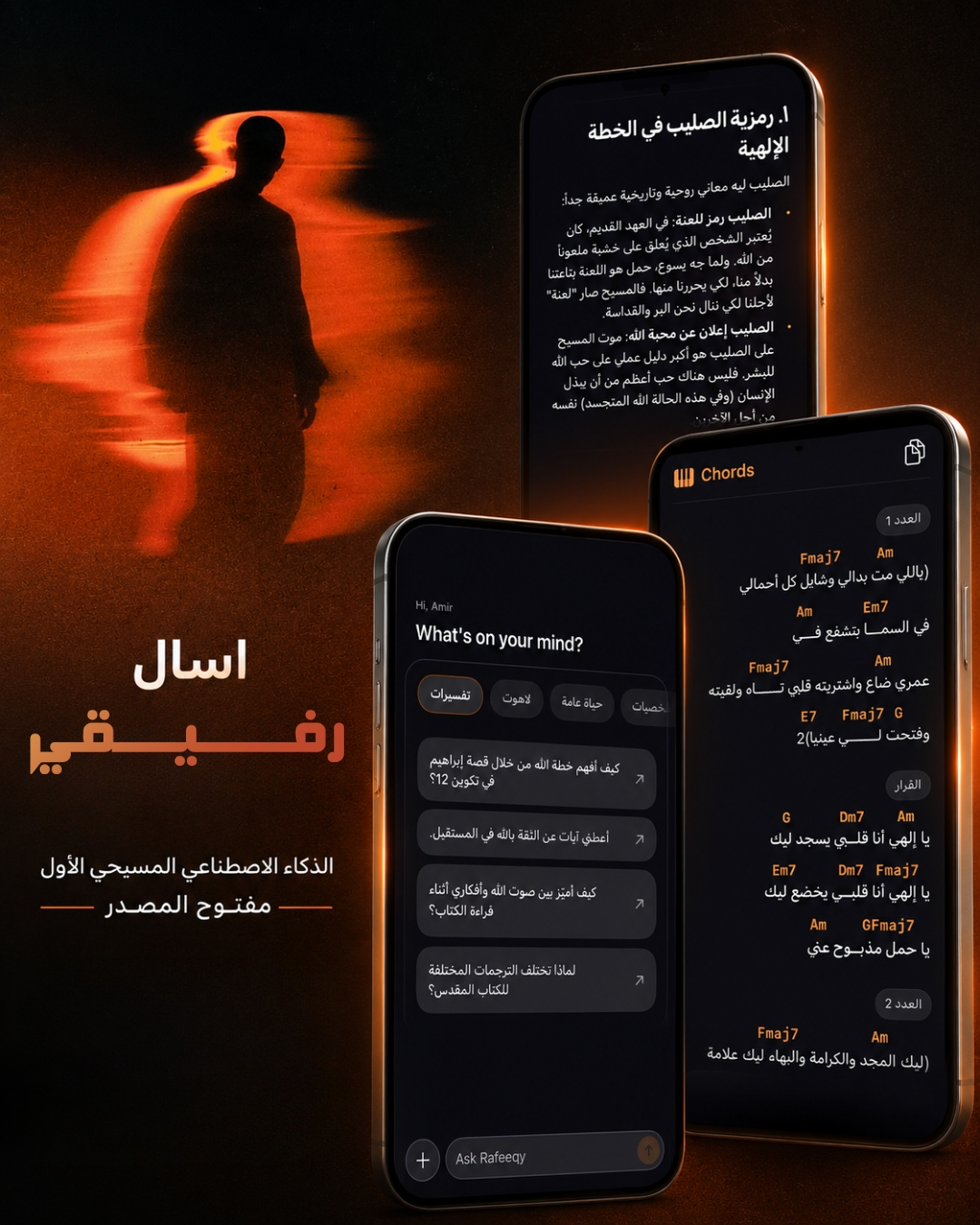
So what does "open source" actually mean?
Before we discuss the other claims, let us understand in plain words: when an AI application says it is "open source," what should you find? And what do you actually find with Rafeeqy?
A genuine open-source application
- Code on GitHubA public page with every line of code. You can open it yourself right now.
- Model on Hugging FaceThe AI's "brain" file is published. Anyone can download it.
- A recognized licenseLike MIT or Apache — clearly written, granting use and modification.
- Independently inspectableAny developer — anywhere — can verify nothing is hidden.
Rafeeqy
- No GitHub pageNot a single link on Rafeeqy's site leads to any code.
- No model on Hugging FaceNo model file you can download or run yourself.
- No declared licenseNo license page at all. The code belongs to Rafeeqy, not to the public.
- Inspection is legally forbiddenThe Terms of Use explicitly prohibit any attempt to discover the code or the model.
Real open-source AI applications — you can verify them right now, yourself
You can open any of them and see the code and the model yourself — even if you do not know how to program. The pages exist, the files are downloadable, and the license is written at the top.
The bottom line, plainly: When an application says it is "open source," you should be able to open the code and see it yourself on GitHub, or download the model from Hugging Face. That is the only meaning of "open source." With Rafeeqy, there is nothing to open. Not one file. Not one line of public code. The claim is a word. The technical reality is its opposite.
"Well, we never meant we built the model — we just use an open-source model."
This is the most likely response if the evidence shows Rafeeqy is not open-source. But it is a retreat that opens a deeper problem than the first: if that is what you actually do, then you are not the developer of a Christian AI — you are a user of a generic model, wrapping it in a Christian skin, exactly like any GPT-4 wrapper.
You did not train the model. You did not choose its data. You do not know what it learned about Christianity, or about anything else. And what you do (System Prompt + RAG + maybe Fine-tuning) is what every developer building on ChatGPT or Gemini does. There is no engineering difference.
Read the full analysis: Who Trained Rafeeqy? →Other claims the investigation uncovers
"Complete Confidentiality — No Humans to Judge, Ask Rafeeqy Anything."
Their Privacy Policy says staff may access conversations, data is used for analytics, law enforcement can compel disclosure, and conversations are retained after account deletion. When asked directly, the AI told users to review the Privacy Policy — advice that comes after they have already shared their private struggles.
Read the full analysis →"Because it's open source and self-hosted, no third-party provider can slip in unfaithful or unchristian content."
Self-hosting prevents a third-party API from altering the model at runtime. It does not touch training data — which is where the model's worldview is actually formed. Rafeeqy did not train the model from scratch, did not select its training data, and has disclosed nothing about it. "Open source" describes a license, not theological content.
Read the full analysis →"Rafeeqy is currently trending — #6 on App Store in Egypt"
The app is listed in the Lifestyle category — not Religion & Spirituality or Reference, where every comparable Christian app lives. Better Life Foundation's own Bible apps are in Books. The app had 6 total ratings at the time, all within a 4–5 day window. Trending in a category with no real competition is not a product milestone.
Read the full analysis →"Every response is grounded in sound Christian teaching — truth you can trust"
Their Terms of Use say AI output "may be inaccurate, incomplete, misleading, or inappropriate" and disclaim all liability. When asked who reviews its theology, the AI said oversight comes from the Better Life team's own programming — not a named committee. In the same response, it declared Sola Scriptura and Sola Fide as universal Christian truths, doctrines explicitly rejected by the Coptic, Orthodox, and Catholic churches — the majority of Arabic-speaking Christians.
Read the full analysis →The Pattern
The most consistent finding across all five claims is a structural split between what the marketing promises and what the legal documents disclaim — applied to the same product, on the same website, targeting the same user:
| Marketing Promise | Legal Disclaimer |
|---|---|
| "Truth you can trust" | "We disclaim liability for reliance on AI Output" — Terms of Use |
| "No humans to judge" | Staff access for support and analytics; law enforcement can compel disclosure — Privacy Policy |
| "Complete confidentiality" | Chat data retained after account deletion — Privacy Policy |
| "Open source" | Reverse engineering legally prohibited — Terms of Use |
| "The model stays unchanging" | "We may modify the Service at any time" — Terms of Use |
| "It will never be locked behind paywalls" | "We may discontinue the Service at any time" — Terms of Use |
This is not a misunderstanding. The emotional promise is in the marketing. The legal escape hatch is in the Terms. The same person reads both — or, more accurately, reads one and does not read the other.
Who This Affects
Rafeeqy is not a general-purpose AI. Its core value proposition is that believers can share their most private spiritual struggles — doubts, sins, marital difficulties, mental health questions — with complete confidence that no human will ever see those words.
That promise is what distinguishes this product from every other AI tool. It is also, per the organization's own Privacy Policy, false.
A user in guest mode — no account, no agreement, no Privacy Policy presented — opens the app, reads "Complete Confidentiality," and shares something they have never told another person. Their conversation is logged. It may be accessed by staff. It can be compelled by law enforcement. It will be retained after any deletion request.
They were never told any of this. They were told the opposite.
About This Investigation
This is not an attack on Christianity, on Arabic-speaking ministry, or on the goal of building faith tools. Those goals are legitimate and valuable. The claims documented here are factual statements — made in marketing, contradicted by legal documents — not matters of theological interpretation.
Sources: rafeeqy.ai (archived 2026-05-14) · Privacy Policy (archived) · Terms of Use (archived) · App Store listing (archived) · ask.rafeeqy.chat